Mostrando postagens com marcador Universe Today. Mostrar todas as postagens

sábado, 5 de fevereiro de 2011

A BRIEF HISTORY OBSERVING OF THE SUN


Em pouco mais de 1 minuto este filmete nos conta a história da observação do Sol.

Muito bem elaborado ele nos permite ter uma noção simplificada da evolução do estudo observacional do nosso "Astro Rei", a importância da tecnologia e a participação de ilustres colaboradores.

(Clique no Logo Universe Today para abertura dá pagina do filmete)


terça-feira, 18 de janeiro de 2011

CORONA HOLES - THE SUN ACTIVITY - CLICK

O Observatório Solar Dinâmico (SDO), numa imagem capturada em luz ultravioleta extrema, em 10 de janeiro de 2011, observou um buraco negro coronal quase no centro do Sol.

Os buracos coronais são áreas da superfície do Sol que são fonte de linhas de campo magnético, origem dos rápidos ventos solares, que "sopram" a uma velocidade constante de 800 Km/s.

À medida que o Sol vai girando, as partículas de alta velocidade do vento solar, irrompendo deste buraco, provavelmente vão atingir a Terra em poucos dias e fazer surgir algumas auroras nas regiões polares do nosso planeta


AN AMAZING REPORT FILM


Coronal Holes are areas where the Sun's corona is darker, colder, and has lower-density plasma than average. These were found when X-ray telescopes in the Skylab mission were flown above the Earth's atmosphere to reveal the structure of the corona. Coronal holes are linked to unipolar concentrations of open magnetic field lines. During solar minimum, coronal holes are mainly found at the Sun's polar regions, but they can be located anywhere on the sun during solar maximum. The fast-moving component of the solar wind is known to travel along open magnetic field lines that pass through coronal holes.

The Solar Wind is a stream of charged particles ejected from the upper atmosphere of the Sun. It mostly consists of electrons and protons with energies usually between 10 and 100 keV. The stream of particles varies in temperature and speed over time. These particles can escape the Sun's gravity because of their high kinetic energy and the high temperature of the corona.

The solar wind creates the heliosphere, a vast bubble in the interstellar medium that surrounds the solar system. Other phenomena include geomagnetic storms that can knock out power grids on Earth, the aurorae (northern and southern lights), and the plasma tails of comets that always point away from the Sun.

The solar wind is divided into two components, respectively termed the slow solar wind and the fast solar wind.

The slow solar wind has a velocity of about 400 km/s, a temperature of 1.4–1.6×10⁶ K and a composition that is a close match to the corona.

By contrast, the fast solar wind has a typical velocity of 750 km/s, a temperature of 8×10⁵ K and it nearly matches the composition of the Sun's photosphere.

 The slow solar wind is twice as dense and more variable in intensity than the fast solar wind. The slow wind also has a more complex structure, with turbulent regions and large-scale structures.

The slow solar wind appears to originate from a region around the Sun's equatorial belt that is known as the "streamer belt". Coronal streamers extend outward from this region, carrying plasma from the interior along closed magnetic loops.

Observations of the Sun between 1996 and 2001 showed that emission of the slow solar wind occurred between latitudes of 30–35° around the equator during the solar minimum (the period of lowest solar activity), then expanded toward the poles as the minimum waned. By the time of the solar maximum, the poles were also emitting a slow solar wind.

The fast solar wind is thought to originate from coronal holes, which are funnel-like regions of open field lines in the Sun's magnetic field. Such open lines are particularly prevalent around the Sun's magnetic poles. The plasma source is small magnetic fields created by convection cells in the solar atmosphere. These fields confine the plasma and transport it into the narrow necks of the coronal funnels, which are located only 20,000 kilometers above the photosphere. The plasma is released into the funnel when these magnetic field lines reconnect.

By Wikipedia

sábado, 1 de janeiro de 2011

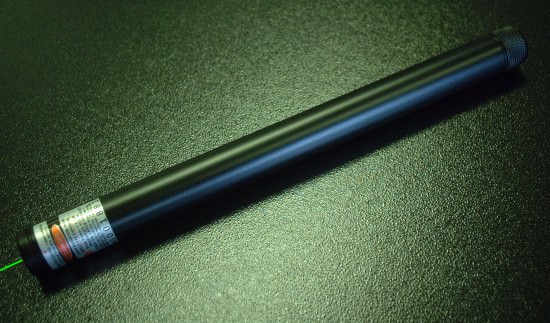
GREEN LASER: ALERT, ELUCIDATION, THINK ABOUT.


Green Laser Pointers – Just Mind Your Manners…

by Tammy Plotner on December 31, 2010


Are you among the thousands of amateur astronomers who received a green laser pointer for Christmas and are a bit afraid to take it out of the box? Do the words “You’ll put your eye out.” ring in your head? Like you, I have a green laser point… and I’ve accidentally shot myself in the eye. To make matters worse, I’ve even had others inadvertently use my retina as a target. Have I gone blind yet?

The answer is no. But I have gotten a nasty headache and had the “flash bulb” effect for a few hours. It’s true that green lasers aren’t toys, but the reality check is that you really need to mind your manners when using one. “With respect to direct personal danger, potential damage to vision is the only real consideration – there is no risk from radiation or enough power in a beam of less than 5 mW to burn anything. However, from a public policy and regulatory perspective, there are actually three areas of concern.” says Samuel M. Goldwater.

“One – Flash blindness from momentary exposure or permanent damage to vision from prolonged intentional misuse. Laser pointers are usually rated Class IIIa or less which means that the power is low enough that the eye should be protected from permanent damage by natural pupil contraction, blink, and aversion reflexes. ?

Two – Distraction and collateral damage – you wreck your car because someone pointed a laser pointer at you while you were driving. Three – Misinterpretation of intent – you get blown away by someone with a BIG gun who thinks you are targeting them with a laser sight. Or, you are arrested and thrown in the slammer for aiming a laser pointer at a cop (this happened recently)
.

As Sam’s fine article on Laser Safety goes on to point out: “While I absolutely agree that intentionally aiming a laser of any kind into someone’s eye is basically stupid (unless you are having laser eye surgery), one must be careful in interpreting the meaning of press reports that describe momentary exposure to the beam from a laser pointer waved around an auditorium resulting in instant total loss of vision in all three eyes.

One would have to direct the beam into the pupil of the eye from a close distance for a few seconds or more without either the eye or pointer moving, twitching, or blinking. Distance is significant both because even laser pointer beams diverge (especially cheap ones) so less energy is able to enter the pupil of the eye as the source moves further away and it is harder/less likely for it to remain stationary and centered on such a target a few mm across.

This is not really possible by accident and even takes significant effort to do intentionally since the eye’s natural pupil contraction, blink, and aversion reflexes will prevent the beam from focusing on a single spot on the retina with a sufficient concentration of energy for more than an instant – not enough time for damage to result.

There would have to be cooperation which can only really happen in a game of chicken – but it is hard to protect people from their own stupidity. This does mean, however, as if it isn’t already obvious, that laser pointers should be kept from infants – period, and away from children unless adequately supervised. Adults, on the other hand, presumably know not to stare into painfully bright lights and some may even read the warning labels!”

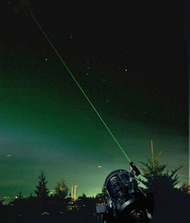
When it comes to green laser pointers, just remember to mind your manners. Accidentally getting “flashed” – or flashing someone else will make you look like one of the most horribly irresponsible astronomers known to mankind. Using a green laser pointer at a star party when someone is doing long exposure deep sky photography might also result in getting your tripod wrapped around your neck. At the same time, responsible use of a green laser pointer gives you an invaluable educational tool that’s as impressive as it is useful.

Just mind your manners…

If you’d like to know more about lasers and safety – from simple barcode scanners to your CD player and more – please visit Samuel M. Goldwater’s Laser Safety pages.
Also, many thanks to the HoTech Corporation for use of the photos.